Colter's Run
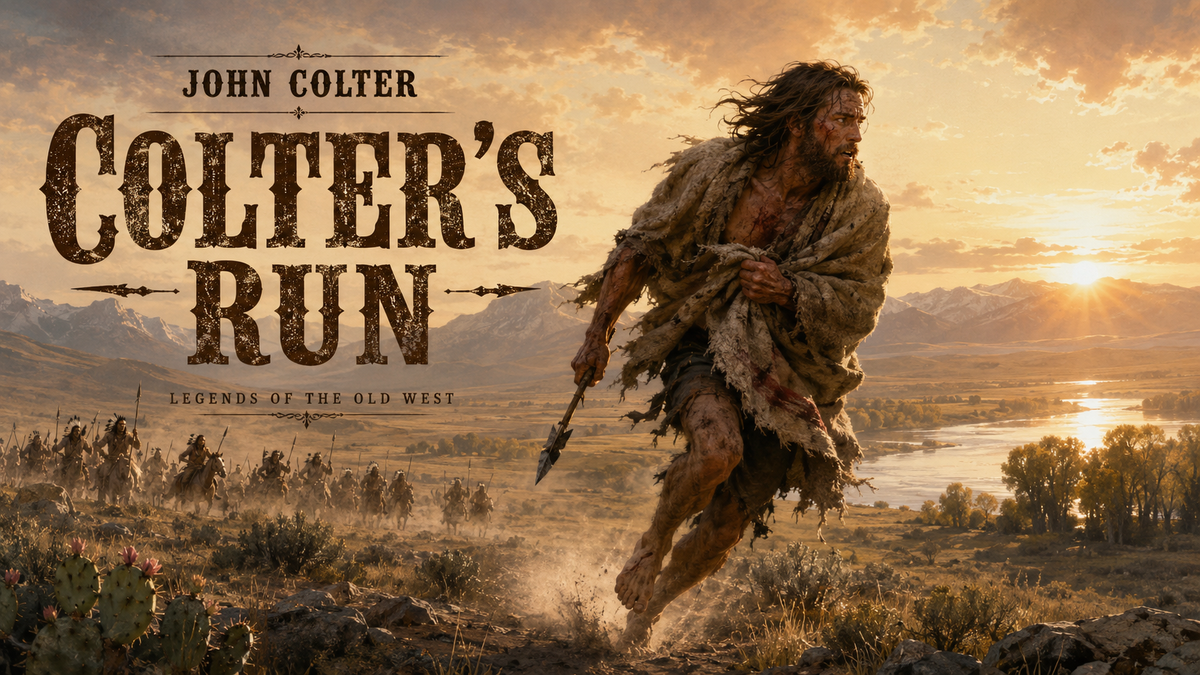
When we last saw John Colter, he was surrounded by hundred of Blackfoot warriors, standing naked on the banks of the Jefferson River. He had just seen his friend and hunting partner, John Potts, hacked to pieces after shooting one of the warriors. Now he watched as the chiefs deliberated for a few minutes before one of them pointed into the distance across the open prairie and told him to go. Colter started walking. When he looked back, he saw the young warriors dropping their blankets and leggings. Colter suddenly knew exactly what it meant. He hadn’t been set free. He’d been given a head start.
This true story of Colter’s Run is the third and final episode about John Colter in this series I wrote for Legends of the Old West. With six miles of open prairie before him, naked and barefoot, with the horns of prairie cactus tearing into his feet and a line of Blackfeet warriors on his trail, Colter made one of the most daring escapes in the history of the American West. He outran all but one of the men, picking up a broken spear and turning to kill the warrior. On the Madison River, Colter dove beneath the water and waited, hiding inside a beaver lodge while warriors stepped on the logs over his head.
He waited out the warriors. But then he had to do something even more impressive. He walked home. With only a Blackfoot blanket and the broken spear, he walked roughly two hundred miles over the next eleven days. He ate tree bark and roots, and when he staggered into Fort Raymond, his friends and fellow Mountain Men barely recognized the skeletal figure staggering out of the wilderness.
And then, after all that, Colter headed back out into the mountains. He trapped for another two years before returning to Missouri, where he married, bought a farm, and for the first time turned down an invitation to head into the western wilderness. When Colter died in 1812, he was only thirty-seven years old. There are less than nine years between when he appears in the historical record and his death. But in those nine years he crossed the continent with Lewis and Clark, trekked across the Rocky Mountains alone, was likely the first white man to set eyes on the Tetons and the geothermal areas on the outskirts of present-day Yellowstone National Park. He survived multiple battles with the Blackfoot tribe and made the most famous run for survival in American frontier history. He didn’t leave behind a journal or a memoir or a map. What he left was a legend.
Available on Spotify:
And Apple Podcasts:

My book, Texas Jack: America’s First Cowboy Star, is available here: