What's Wrong with the Gruffalo?
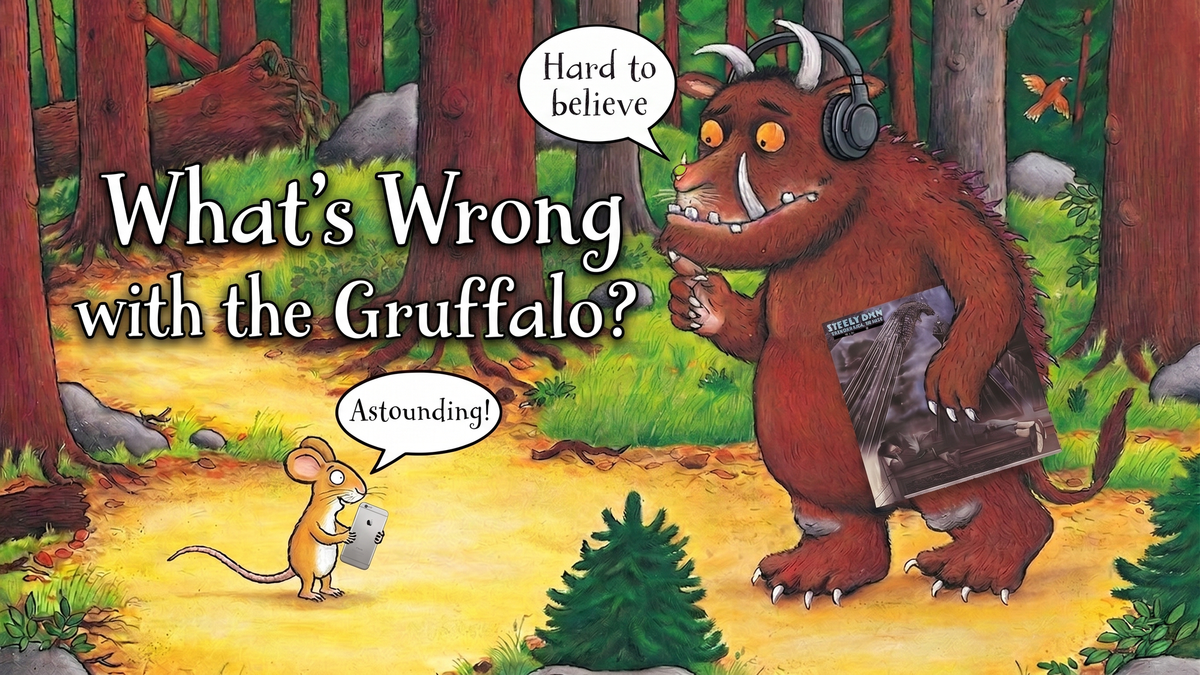
On Sunday afternoon, my daughter Emaline and I went over to the Red Bank Community Center. The small municipal building was packed with young children and their parents and grandchildren, who had all come to see the Chattanooga Symphony Orchestra's Wind Quintet playing classical music, accompanying a reading of the classic children's book The Gruffalo.
Most of the children there were young. My daughter turned twenty-one this year. But I don't think you're ever too old, or too young for that matter, to enjoy a little nostalgia.
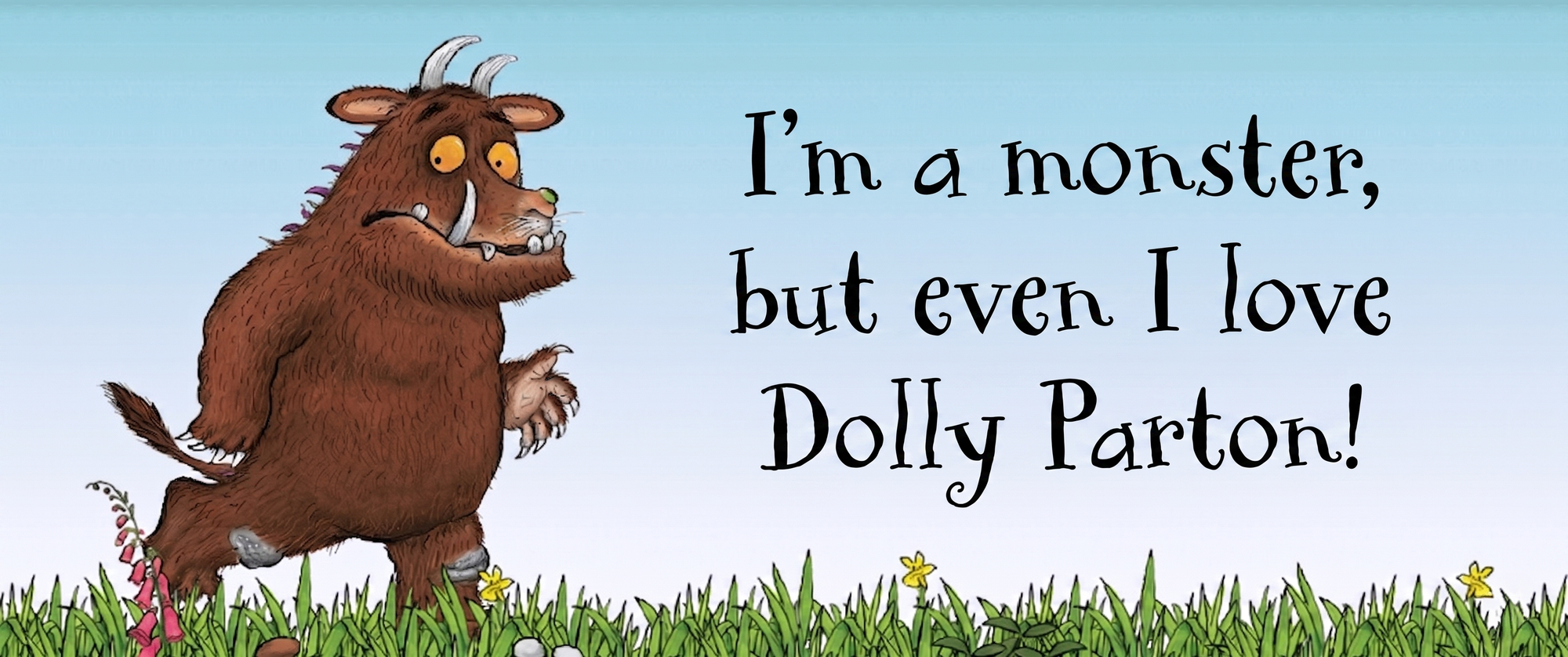
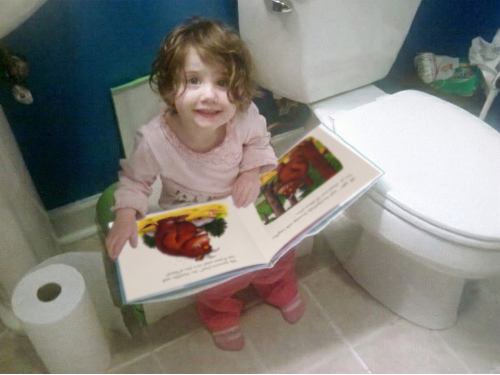
The Gruffalo entered our house when Em was very young, courtesy of Tennessee's resident patron saint Dolly Parton and her wonderful Imagination Library, which sent free books to her in monthly installments throughout her early childhood. I read it to her, by my reckoning, somewhere between four hundred and four thousand times. The exact figure isn't important. The point is that I read it enough that I didn't then and don't now need the book in front of me to recite it. The words have taken up permanent residence in my brain, in the same file that remembers all of the lyrics to Ice Ice Baby and every line of dialogue from the movie Tombstone.
Emaline impressed her grandparents when she was young with being able to "read" The Gruffalo perfectly. I resisted spoiling the magic by telling them that she had memorized it too.
So when the good people that were running the event this Sunday handed out complimentary copies of the book, I cracked it open, heavy with nostalgia. And the first thing my mouth did was reject what my eyes were reading.
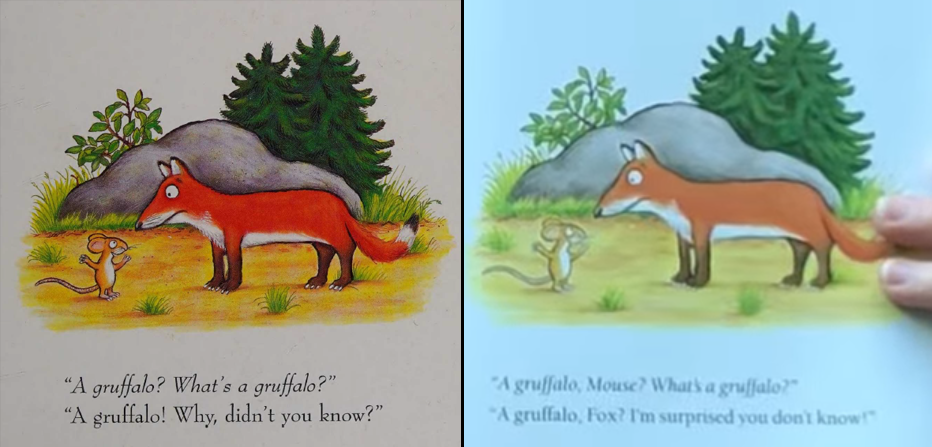
"A gruffalo? What's a gruffalo?"
"A gruffalo! Why, didn't you know?"
Wrong. That's wrong. Not right. Wrong.
The version I had read for years went:
"A gruffalo, Mouse? What's a gruffalo?"
"A gruffalo, Fox? I'm surprised you don't know!"
A few pages later, when the mouse has just terrified the fox, owl, and snake by parading the gruffalo through the woods, the gruffalo marvels:
"Amazing!" said the gruffalo.
In the version I remember reading to my daughter, it was:
"Hard to believe," said the gruffalo.
I read on, increasingly incredulous, finding small substitutions throughout. Not whole new pages. Not different art. Just — an off-by-one rhythm, a substituted word here, a missing vocative there. Like hearing a song I'd known my entire life played back fractionally faster than I remembered it.
I did what any normal middle-aged person does when reality fails to match memory in a small, specific way. I pondered that I might, at long last, have made a mistake. I considered admitting, for a fraction of a moment, that I might have been wrong.
The brain contextualizes. It adds "Luke" to "I am your father," "Scotty" to "Beam me up," and "Sam" to "Play it again." Maybe it added Fox, Owl, and Snake before "I'm surprised you don't know."
It's a humbling thing, getting older, to discover how unreliable your memory is for the things you were the most sure you knew. I write for a living. One of the things I write about for a living is history. Knowing the fallibility of memory, I am, professionally, supposed to know better than to trust myself about which exact words appeared in a children's book I last read closely a decade ago. So I tried, honestly tried, to shrug it off.
Because I know how the brain works. It isn't just the contextualization. The brain compresses. The brain reconstructs. The brain does not store text. It stores rhythm and gist and then improvises words to match. Of course I'd drifted. Of course the version in my head was a composite of between four hundred and four thousand bedtime performances slowly diverging from the source. That's how this is supposed to work.
Except.
Except the rhythm. The rhythm was the thing my mouth knew. And the rhythm of the book in my hands was wrong.
I tried to let it go. I could not let it go. I asked my wife what line followed "I'm having a feast with a gruffalo?" I called Cherith, my oldest daughter, to see if she remembered the exact words, and she told me that when she bought a copy for my granddaughter, Celene, some of the words seemed...odd.
I started searching online, looking at every version in the Internet Archive and Anna's-Archive and several other sources looking for the version I remembered. I looked on YouTube for old readings of the book, videos of parents, classroom read-alouds, anything. And eventually, on a Facebook Live recording from Union Elementary School in Excellence, West Virginia, I found a live recording by a Mrs. Jeffries, holding open a hardcover edition, reading to the screen, and saying, clear as can be:
"A gruffalo, Mouse? What's a gruffalo?"
"A gruffalo, Fox? I'm surprised you don't know!"
A few minutes later, after the mouse has worked his magic on the predators:
"Hard to believe," said the gruffalo.
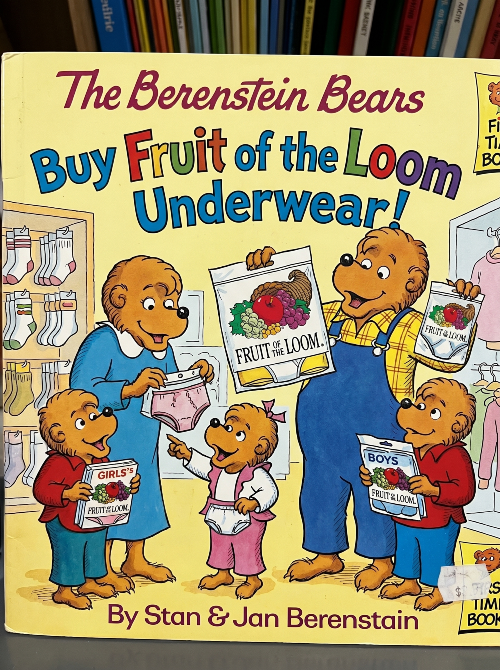
I knew I wasn't crazy. I wasn't misremembering. This wasn't, as both of my daughters and my wife repeatedly suggested, my own personal Mandela Effect. This was no Berenstein Bears or cornucopia behind the Fruit of the Loom logo. The version I had read hundreds of times existed. It was real. It had been printed in a book and sent to my house by Dolly Parton, and a woman at a school in West Virginia had received the same edition and was, on the day of that video, reading it aloud in exactly the words my brain knew it knew.
The relief was, I'll admit, disproportionate to the stakes. I am a grown man. This is a children's book. It isn't that serious. Nobody died. And yet I felt the kind of hard won vindication you feel when, after a long argument, someone you love finally concedes that yes, you did say that, you were right, you remember correctly. I was not making this up.
I strutted like a peacock into the living room, silently demanding my wife's attention until she paused the show she was watching, and loudly proclaimed precisely how correct I had been.
So what happened?
It turns out the book my daughter received from Dolly Parton in 2007 or so was not the standard Julia Donaldson rhyming-couplet edition that most of the world knows. It was a leveled-reader adaptation, retooled to hit a specific Lexile reading score (340L, in the trade) for use in American school programs. The Lexile system is a measure of text difficulty used by school districts and reading partners to match books to students at the right level. Publishers commission adapted versions of popular books to fit those targets. The adaptation is performed by an uncredited editor, who shortens sentences, simplifies vocabulary, and — in the Gruffalo's case — restructured the dialogue so that readers could more easily track who was speaking. Hence the inserted vocatives: Mouse? Fox? Owl? Snake? They are scaffolds for a six-year-old reading alone. They tell the kid which animal is talking.
It is a sincere, well-intentioned, pedagogically sound adaptation. There is no villain here. Nobody set out to alter Julia Donaldson's verse for ideological reasons or to pad sales. Some editor at Penguin's American imprint, doing their job, made a children's book accessible to an emerging reader. Good for them.
But there's a side effect, which is what my mouth was responding to all those years. The vocative — Mouse? Fox? Owl? Snake? — does enormous work the original line doesn't. It personalizes each exchange. It builds a little caesura into the rhythm. It lets the mouse, who is essentially running a long con on a forest full of predators, sound theatrically incredulous when he says "I'm surprised you don't know!" — like a worldly dinner-party guest mildly aghast that you, you of all people, haven't heard of the Gruffalo. The whole story is about a tiny creature whose only weapon is rhetorical confidence. The Lexile-adapted version, by accident, gives the mouse a sharper voice for that performance than the original did.
It is the rare case where the simplified version of a thing turns out to be, on the merits, better...or at least, better suited to being read aloud by a parent doing the voices. Which is what my mouth had been doing for between four hundred and four thousand readings over however many consecutive nights.
And look, if you grew up reading or being read the standard version, you're likely saying, internally or externally, that there's no way — NO WAY — that my version is superior to yours. So please, please, do me this one small favor and consider the difference between these two passages. In the story, the mouse and the gruffalo are wandering through the woods together, as the mouse tries to convince the gruffalo how frightened all of the other woodland creatures are of the little mouse.
The standard version goes like this:
"It's Snake," said the Mouse. "Why, Snake, hello!"
Snake took one look at the gruffalo.
"Oh, dear!" he said, "good-bye, little mouse,"
and slid right into his log pile house."
And our (superior) version is:
It's Snake," said Mouse. "Why, Snake, hello!"
Snake stared hard at the gruffalo.
"Oh, shivers!" hissed Snake, "Good-bye, little mouse."
and slid right into his log pile house.
Look at that beautiful alliteration. Snake stared. Shivers. And then, he didn't say "Good-bye little mouse." He hissed it. It's just better. It is.
I'm not going to argue that the standard Donaldson version isn't the canon, because it clearly is. Its what most of the world knows and loves as The Gruffalo. It's what your kid will get if you walk into Barnes & Noble today and buy a copy. The version I read to my daughter is, by every measure that matters bibliographically, the aberration. As best as I can tell, it's out of print. Functionally unobtainable. It exists now in a few thousand households that received it through the Imagination Library between roughly 2007 and 2012, and in a handful of leveled-reader programs, and on a Lexile PDF that MetaMetrics hosts on their website without any indication that it represents a meaningful departure from the published text.
And here's the part that has stayed with me. I'm not actually upset about the Gruffalo. I'm moderately charmed by the discovery. I love that some anonymous editor, who will never know how much I appreciate them for it, accidentally wrote a better script. I love that my daughter and I share a private edition of a famous book that almost nobody else has. I love that her literary memory and mine are calibrated to a text that has, in a sense, become ours.
What unsettled me, what kept me up turning this over in my head, what made me look at let's just say more than a couple of online versions and live readings of a children's book, was the realization of what would have happened if I hadn't found that Facebook Live video.
Without the video, I would have walked away believing I had somehow misremembered. The new copy in my hand would have been the Gruffalo, and the version in my head would have become a curiosity of my unreliable mind. My daughter would have had no reason to trust her own memory either, because her version came from me. We would have collectively re-canonized the standard text and quietly forgotten that we had ever known another. The displacement would have been complete and invisible.
That's the part of this that won't stop ringing.
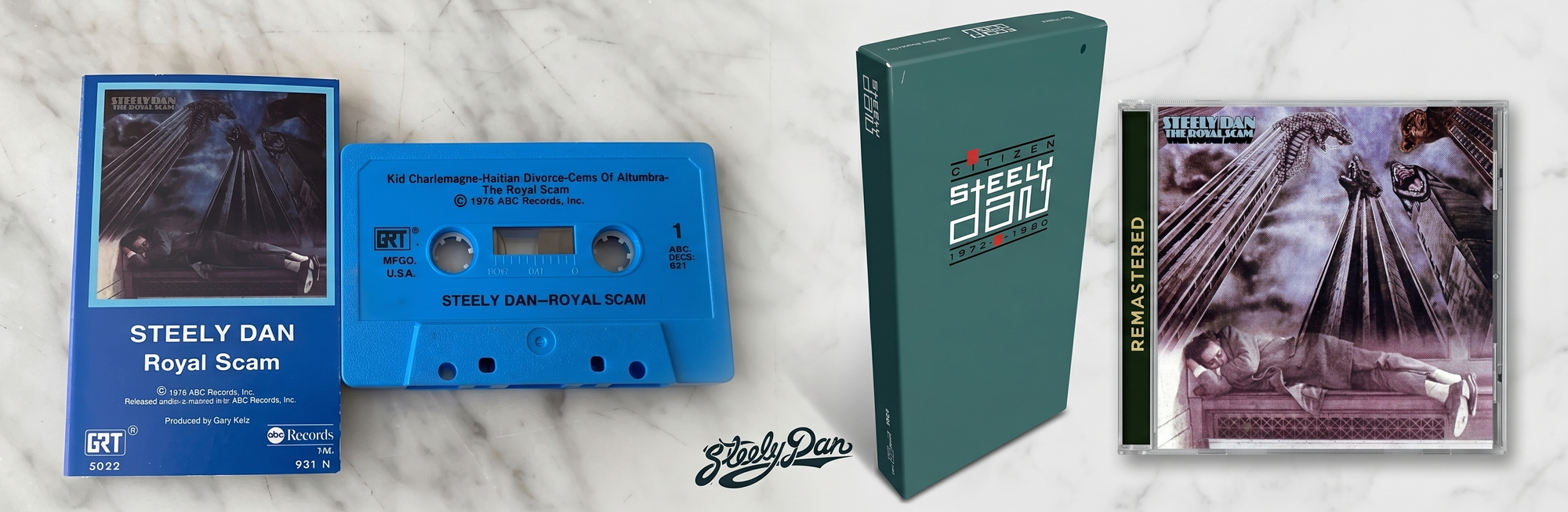
I came of age listening to my dad's Steely Dan cassettes that lived in the family Suburban for a decade of vacations. Then, when I was in high school, to the Citizen Steely Dan box set, which my friend Amanda shipped to me direct from Walter Becker himself. Later, I spent my hard earned money on the brand new remastered cds. Multiple formats, multiple sources, and one canonical Kid Charlemagne that lived in my body the way the Gruffalo's verse lived in my mouth.
If I tell my phone, today, in 2026, to play Kid Charlemagne, the version that comes out of the speakers is not the version I grew up with. The recent remasters run a hair faster on certain tracks. The reasons are contested in audiophile forums, blamed on VSO (Variable Speed Oscillator/Operation,) and not particularly interesting to anyone outside them. What is interesting is that the version of the song my dad played for me, the version that came out of the cassette deck in the Suburban, the version on the box set Walter sent and the remastered cd that followed — that version is now retrievable only if I dig out the physical media and play it on a physical device. The version my phone serves up by default has been quietly edited. My Kid Charlemagne is nearly 6 seconds longer than what's on Spotify and iTunes.
Nobody told me. There was no announcement, no asterisk, no please note the runtime has changed. The streaming service does not say "you are hearing the 2023 mastering, which differs from previous releases." It just says Kid Charlemagne, by Steely Dan, and plays you what it plays you. If you weren't already familiar with the prior version, you would never know. And the people who could authoritatively say which version is correct — Walter Becker, Roger Nichols, etc — are mostly dead. The canonical Kid Charlemagne, for most listeners, is whichever one they've heard first and/or most often.
Here is a thought experiment. Imagine you could pull, from the back of a closet, a VHS copy of Shazaam — the 1990s genie movie starring Sinbad. You remember it. You rented it from Blockbuster. You can describe scenes from it. So can thousands of other people. The internet, however, will tell you flatly that this movie does not exist and never did, that you are confusing it with Kazaam, the Shaq movie, that your memory is faulty. Without the tape, you have no way to argue back. You can describe the cover all day. You can't produce it.
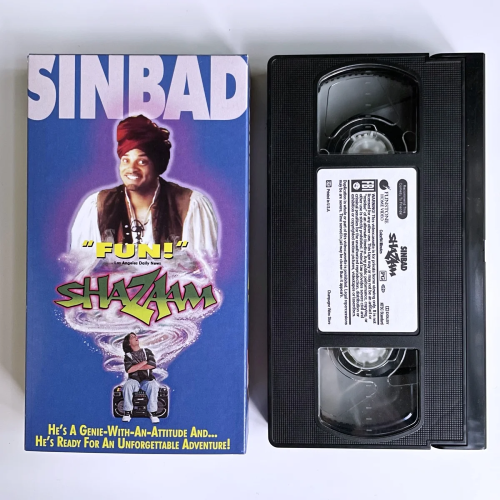
That's the position I almost ended up in with the Gruffalo. That's the position my dad would find himself in if he tried to convince a younger person that Kid Charlemagne used to be a different length, and didn't have the Citizen Steely Dan box set to throw into the old five-disc changer to prove it. The artifact is the witness. Without the witness, memory is just a feeling, and feelings — in the age of streaming and subscription and silent server-side updates — are no match for the version that comes out of the speaker.
What I've learned from the Gruffalo, and from my phone's slightly-wrong Kid Charlemagne, is that the question isn't whether the new versions are right or wrong. My Gruffalo is the aberration; the standard rhyming Donaldson is canon. My Steely Dan is canon, as far as I'm concerned; the new mastering is the aberration. Either way, the interesting problem is not which version is correct. The interesting problem is that, increasingly, we have no way to verify our own memories of cultural artifacts against the artifacts themselves, because the artifacts are no longer artifacts. They're feeds. Feeds get edited. Feeds don't ask permission.
I'm going to find my daughter's original copy of the Gruffalo. It's almost certainly at my parents' house, on a bookshelf in the girls' room upstairs, and I'm going to set it aside for her own children, when they come. Not because it's the right version. Its not. But because it's the version her mother and I read to her, between four hundred and four thousand times, and one day she may want to read it to a child of her own in the words she remembers, and not the words she'd find in a book that wasn't her version. Our version.
That is what physical things are for. They're how we keep memory from being quietly overwritten. They're how we hold the line.
The version of things that lives in your house is the one that's true. It's the right one. Even when it's wrong.
Matthew Kerns is the Spur & Western Heritage Award winning author of
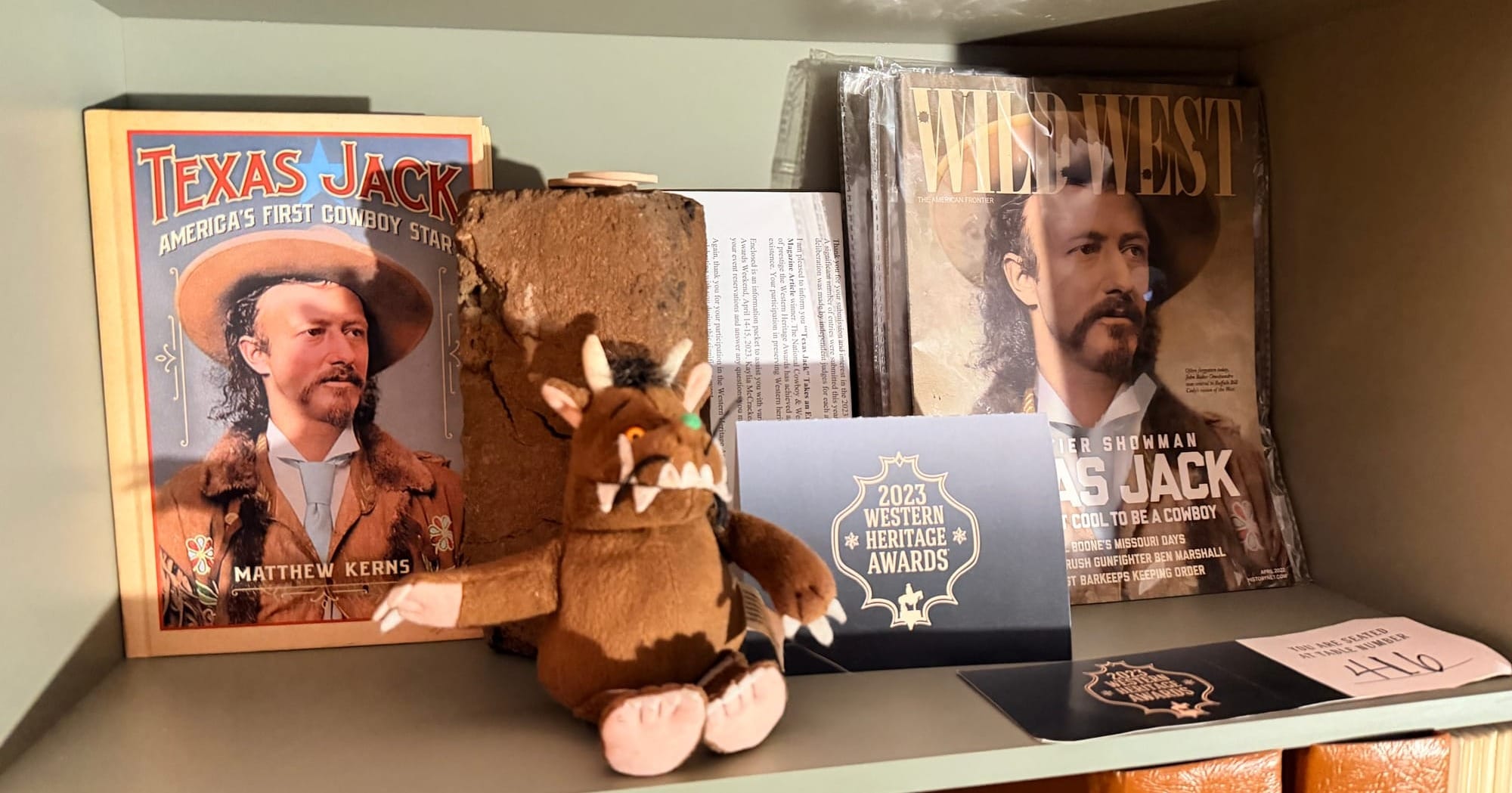
Texas Jack: America's First Cowboy Star. When he's not fretting over a few words in a specific version of The Gruffalo, he is busy querying his first novel.