
Whoever We Are By Then
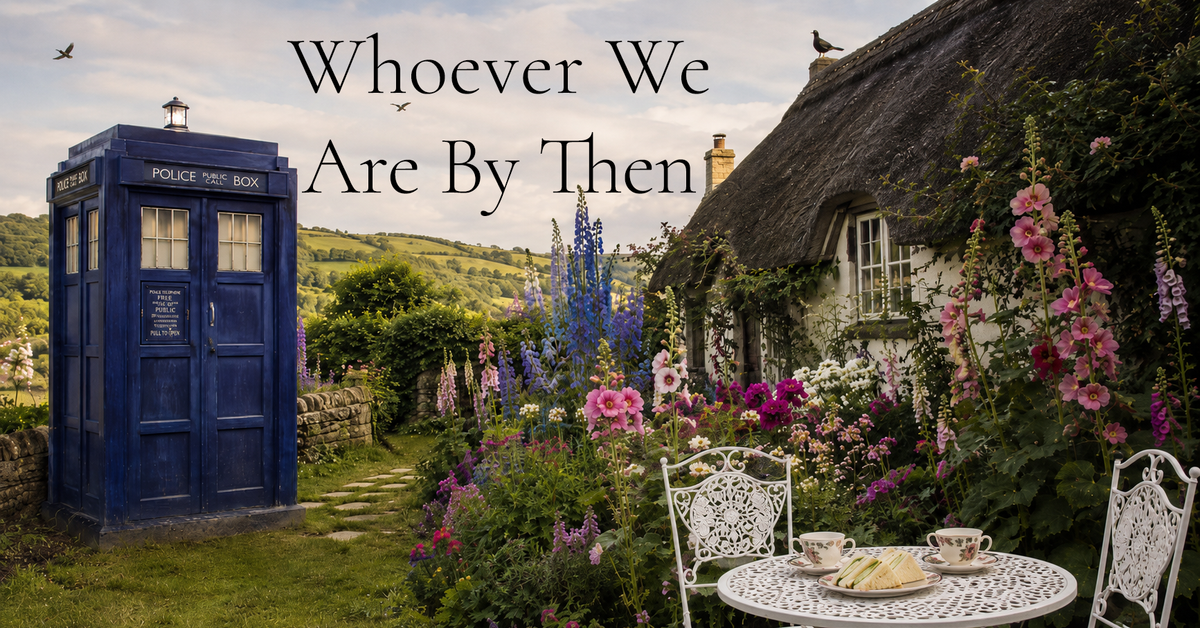
Vworp. Vworp.
The sound filled the garden at the same time as the wind of the arrival bent the foxgloves and the light spinning on the top of the machine briefly illuminated the hanging eaves of her home. She didn't even turn her head. Instead, she simply nodded to herself, dropped a pair of sugar cubes into the porcelain cup full of tea she had already poured, and smiled.
Her grandfather was home.
The doors to the Police Box that now dominated her little garden didn't open so much as detonate.
He came out the way he always came out when he thought the world was on fire. Moving fast, already talking, his feet off and running before his chin hit the ground. "Right!" The sonic was up and sweeping the horizon before he'd cleared the doors, scything left, then right, reading the air for whatever had screamed loud enough to drag him out of the middle of something burning.
"Where is it, where is it, I got the signal, I got the — Susan? Susan, stay back! Stay behind me, girl! It said you were—"
He stopped.
Not because she'd said anything. Because there was nothing to point the screwdriver at.
There were primroses. There were delphiniums standing to attention in their neat blue rows, and phlox and dianthus and hollyhock. There was a wren somewhere being unhurried about the afternoon. There was a small white table set for two, a plate of cucumber sandwiches in the center with the crusts cut off, a cup of tea steaming gently on the side nearest him.
And opposite it, in a cardigan, in no apparent danger whatsoever, blowing the heat off the top of her own cup, was Susan.
She watched him do the thing he did. The recalibration. The whole magnificent engine of him spinning down through its gears having attuned prepared itself for a threat and turning up a garden party. The screwdriver stayed up. He made a slow half-turn with it, as though the danger might be being clever, might be behind the little shed, behind the wisteria, beneath the sandwiches.
"It's all right," she said. "You can put it away."
The screwdriver was the last thing to understand. Its light guttered out, and he stood there a moment longer with it still raised, the way a conductor keeps his baton up after the music stops, and then he finally noticed it and lowered it and looked, properly, at her.
"There's no Boss," he said. Trying it out.
"No."
"But you called me. That signal was you. You pulled me out of—" he gestured at the sky, at the wherever he'd been, the burning thing he'd left mid-rescue. "You called me here. To…a garden?"
"I called you here,” she said, “for tea. Now sit down before it goes cold. Too many teas that I’ve poured for you have gone cold, and just this once, I’d like to see you try one while it is still warm."
He didn't sit. He never sat. He was a man built to remain standing in case the room turned out to need saving after all, and she had loved that about him and grieved that about him in roughly equal measure for longer than she cared to total up. She watched him take in the garden instead, waiting patiently as she watched for the precise moment he allowed himself to see how old she'd got, and then watched him decide not to have seen it.
That was new. He didn't usually have to decide.
"Sit," she said again, gentler, and this time, because it was her, he did.
The chair was too small for whoever he was now. They always were. He folded himself into it with the sheepishness of a man made small in his grandmother's garden — except it was the other way round, it was always the other way round, the granddaughter older than the grandfather by more years than either of them said out loud, and neither had ever once known what to do with that arithmetic except fail to mention it.
He picked up the cup. He looked at it the way he looked at everything, like it might be a trap or a puzzle or a door. Then he drank, and she saw it cross his face. The small, stupid, enormous surprise of it.
It was warm.
He looked at her over the rim, and for the first time since the box had screamed itself into her garden he wasn't the Doctor at all. He was just a boy who'd done the sums and didn't like the answer.
Now, she thought. While you're sitting still. While it's warm.
"Grandfather," she started and didn't finish, because the word went where it always went, which was backward, looking for him and finding too many of him to choose from. She had a gallery. Every face he'd ever worn into her life, kept and pressed flat between the years like flowers in a book, and she could have laid them out across the tablecloth like a hand of cards.
The last time, he had not looked like this.
The last time had been the girl's wedding. The marquee at the edge of a hot July field, the air gone heavy with cut grass and someone's perfume, and not seated on the side with bride’s family but there at the back, past all the hats, a man wound round and round in a great long scarf he had no business wearing in that heat, with a mouth full of teeth and eyes like a delighted owl. Too old to be a friend of the couple. Too strange to be anyone's friend at all. Who is he, the family had murmured, the way families do, and she had said oh, an old friend, from a long way back, because what else was there to say. He was no one's. He was hers. And she was the only soul in that field who knew it.
She'd known him across the whole length of the marquee the instant she saw him. She always did, now — more by his presence than his face. It hadn't always been so easy. She'd learned it the hard way, the first time, when the man who came through her door was not the man who'd gone out of it, and a stranger stood on her step saying her name as though he had some right to it, and she'd had to decide, with her heart pounding in her chest like a hammer, whether to believe him. After that she never had to decide again. His faces changed. Her knowing didn't.
He stayed at the back through the speeches, laughing at the best man's jokes a half-beat early, the way he did, having read the room or the afternoon or both. And somewhere between the cutting of the cake and the first dance, when she turned to find him, he was gone, the way he was always gone. In the photographs afterward, if you knew where to look, and she always knew where to look, there he was at the very edge of the frame, a stranger watching the bride. He would be at the edge of other photographs too. Other weddings. Other faces. Always the edge. Never once in the middle. Never quite in focus.
She came back up out of it the way you come up from deep water, and the tea was still warm, and he was still folded into the chair that was too small for him and he was watching her. Watching her face the way she had watched his a thousand times, waiting for the exact moment it gave something away. And she understood, with a small cold start, that the watching had changed hands.
"There's a thing I've been—" she began, and got no further, because he was already up out of the chair the way water finds the crack in a dam.
"The last time I saw you," he said, too quickly, too brightly, "my last time, I mean, yours is different, isn't it, yours are always different…was the orchard. You remember the orchard? Course you do. The blight, the whole crop turning to glass overnight, and you'd worked out it was temporal before I'd got my coat off—" He was pacing now, narrating, conducting the memory like it was a rescue still in progress. "Brilliant, you were. Saved the lot. I just stood about, stroking my mustache, looking decorative. I was traveling with Belinda and..."
"You came alone," she said.
It stopped him the way a hand on the chest stops a man. He sat back down.
"You always come alone." She set her cup down. "How many years, Grandfather. All those faces, all those friends…but you've never once brought them. Not to my table. Not to me." She watched him not have an answer. "Why is that, do you think?"
"Busy," he said, picking up and examining a cucumber sandwich. "Timing, you know. It's never—"
"No," she interrupted, kindly, which was worse than if she'd been cruel. "It's because they'd see you sit down. And you can't have that. The whole universe gets the man who never sits. I'm the only one who might expect the man who does, and I think you'd rather die than let the two of them be in a room together."
He set the sandwich down, uneaten, on the rim of his plate, and for a moment she thought she'd pushed too far too fast, and that he'd do the thing he did when the truth got close; find a reason, somewhere or somewhen over her shoulder, to be urgently elsewhere. But he didn't stand. He turned the cup a slow quarter-turn on its saucer instead, and she understood that this, too, was new. He was staying.
"You always know me," he said. Not quite a question.
"I always know you."
"Even when I make it difficult." A ghost of the old grin. "And I know I made it difficult."
"You've made it garish," she said, and watched the grin take. "There was the one in the coat. You know the coat. I'll not describe the coat, it doesn't deserve the words. But you walked into a christening for Margaret's eldest, made up like a paint factory that had lost an argument with a stained-glass window, and you had the brass, the absolute brass, to ask me why everyone was staring."
"I liked that coat."
"No one liked that coat, Grandfather. That was the coat's whole tragedy."
He laughed. He laughed a genuine laugh. One that surprised him on the way out, and for a moment the garden held nothing else. Then it faded, the way they always faded, down into the abiding quiet that lived under everything between them.
"And the spiky one," she went on, because she'd decided to walk this road and the faces were the paving stones. "The thin one. All teeth and hair and running everywhere. He came twice, that one. Or—" she frowned. "I thought he came twice. I thought he was the one who couldn't bring himself to leave. Turned up again in the same face, like a date he'd not quite finished with."
"There were two of those, actually." A touch too eager, reaching to correct it, to make it clever, to make it lore. "Two of me, same face, it's a whole—"
"I know what it was." Gentle, and it closed the subject like a hand closing over a coin. "I just thought it was the one who stayed too long. I'm old. I'm allowed to find one man easier to believe in than two."
And there it was. The door she'd been walking toward the whole time, standing open in the middle of an ordinary sentence, and she went through it before her nerve could fail.
"Because that's the thing I called you about. The staying too long. The not knowing which of you is which or which of you is next." She kept it level, conversational, the voice you use for the weather, because if she let it be anything else the words would not come at all. "The next time you come to this garden…and you'll come, I know you'll come, because you always come… it won't be me who meets you. Not this face. Not this—" her hand made a small vague circle at her own cheek, her grey hair, the whole worn familiar fact of her. "There's going to be a change."
She made herself look at him as she said it.
And she watched him do the one thing she had never, in sixty years and a dozen or more faces, seen him do. She watched him refuse to understand. Watched that great quick mind take the sentence, turn it over, set it down unopened, and reach instead — openly, helplessly,like a man patting his pockets for keys he knew weren't there — for something else to say.
"More tea," is what he found. Already reaching for the pot. "That's…yes. I think. Don't you? More tea."
She let him pour it. First whacks never land; she'd known that walking in. She let him pour with a hand not quite steady, and she thought: all right. Not yet. But soon. Before the pot is gone. Before it gets too cold.
The afternoon David died, she had not called anyone.
There had been nothing to call about. The doctor — the ordinary kind, the kind with a bag and a stethoscope and a tired face — had been and gone and left the words make him comfortable hanging in the room, and after that there was only the waiting, which she did in the chair by the bed she had pulled close years ago and never pulled back. The light went long and gold and then grey across the windowsill. David's breathing did the thing she had been warned it would do, the long gaps, each one a question the next breath kept answering until, eventually, it didn’t.
Her left hand had been holding David’s the whole time, but she didn't know how long her right hand had been clutching his.
And then she became aware, the way you become aware of a clock that has stopped ticking, of the warmth against her palm that she hadn’t known she had needed.
She hadn't heard the box. That was the thing she'd think about, after. That for the first and only time in sixty years, the vworp had not come, or had come so softly, so unwilling to intrude, that it had folded itself into the house's ordinary creaks and let her be. He had not arrived. He had simply, at some point in that long grey afternoon, been there. Sitting beside her in a chair that had not been in the room before, in a dark coat, saying nothing at all.
She turned and looked at him.
An older face this time. Sharp. A great pair of eyebrows pulled down over eyes that had plainly seen the inside of more grief than one man's fair share, and were not, now, just this once, trying to fix any of it. He wasn't reaching for the screwdriver. He wasn't casting about the room for the thing to defeat. There was nothing here to outrun and he knew it, and he had come anyway, and he had taken her hand anyway, and he was simply going to sit in it with her, for as long as it took, because that was the only thing left that was any use.
Of course, she thought. Not surprise. The opposite of surprise. Of course you're here. Where else would you be.
He didn't say he was sorry. He didn't tell her David had been a good man, though he had, or that she'd made a good life, though she had, or any of the things the village would say to her over the coming week with their casseroles and their lowered voices. He looked at her from under those terrible eyebrows, and his thumb moved once, slowly, across the back of her hand, and that was everything. That was the whole eulogy. I'm here. I've got you. You are not alone.
They sat together while the light went out of the room and David went out with it, and the grandfather she had pounded a locked door to follow held the hand of the grandmother she'd become, and neither of them said a word, because there were no words that were better than the hand.
Later, she never knew how much later, there were two cups of tea on the bedside table that she had not made.
She never drank hers. It went cold beside her while the house filled up with the business of death, the calls she finally made, the people who finally came. But she noticed, in the days after, that the other cup was gone, and the chair was gone, and the box that had never made a sound when it arrived also didn’t make a sound when it left, and she understood that he had stayed until she was no longer alone in the house, and then had taken himself away without a word so as not to be one more thing she had to manage.
He had even washed his cup. She found it in the rack. The man who could not sit still had stood at her sink, in the dark, and washed and dried a single cup and put it away, so she would not have to.
That was the one she thought of, when people asked her, and a few, over the years, had dared to ask, whether she ever heard from her grandfather anymore.
She always said no. It was easier. And it was, in the only way that mattered, the furthest thing from true.
She came out of her thought and back into the garden, where the tea had cooled a degree but not gone cold, not yet, and he was watching her again, he'd never stopped, with the cup small in his hands.
"You're remembering at me," he said. "I can always tell. You go somewhere I can't follow." A pause. "Which is a thing I usually do to other people."
"I've earned the right to do it back."
"You have." He said it simply, and it cost him something, and she let him pay the cost.
She picked the thread up again, more carefully this time, the way you test a stair you know to be loose. "You came for the big ones," she said. "Every one. I'll give you that, and I'll give it to you with both hands, because it's true and because you should hear someone say it before—" she stopped, went round. "When the Daleks came the second time. You remember. Half the world under occupation again and the rest of us pretending the curtains being shut was about the something else. And there you were on my step of a morning, all in cricket whites, of all the mad things, a stick of fresh celery in your lapel like the world wasn't ending when it was, it absolutely was, and you winked at me and said mind if I borrow your planet a moment. And off you went and gave it back better than you found it, the way you always do."
"I remember the celery," he said, with great dignity, "It did good work."
"You were ridiculous. You were marvellous. You were always both at once, and that's the trouble with you." She turned her cup. "And when the sun went out—"
The garden seemed to dim a half-shade, though it didn't, and the afternoon held.
"That one I didn't like," she said quietly. "I'll tell you that now, since we're telling. The sun went black at noon and the birds all stopped and the whole sky was wrong, and the box came, and I was glad in the way I'm always glad right up until you stepped out of it." She made herself hold the memory steady. "You were old. Older than the rest of you ever let yourselves look. A beard going white and eyes that had — I don't know how to say it. Eyes that had done a thing. Seen a thing. You didn't tell me what was wrong and I didn't ask, because for the first time in all my long life, Grandfather, I looked at your face and I was frightened of it. Not of the sun gone out. Of you. Of whatever you were carrying that day. That you." She let it settle. "You put the sun back. Course you did. And you left without your tea, and I was, God forgive me, I was relieved to see the box go."
He didn't defend it. He looked into his cup as if an escape from the discomfort might be down at the bottom of it, and for a moment she'd have given the rest of her years to know what he was seeing.
"So I know what it is to watch your face show up as something I have to brace for," she said — gently, gently, this was the loose stair, this was the one — "which is why I have to tell you that the next time you come, the face that won't be ready will be mine, and I need you to not be—"
"What about the wedding?" he blurted out.
She blinked. "What?"
"Your wedding, girl," The words came fast and warm and frightened. "Oh, that was a delight! David looking so dapper in his tuxedo and you in your gown!"
"You were the maid of honor," she said, and the laugh came up out of her before the grief could, which was a welcome surprise.
Because he had been. That was the joke of it, the joke she'd kept folded in her pocket for forty-odd years and taken out, now and then, on the grey days, to make herself smile.
She had asked him. Had written him, the only way she had, a letter left on the kitchen table by a window left unlatched, the way you'd leave milk out for a cat that came and went, asking him to give her away. There was no one else to do it. Father was a word she didn’t have a definition for and never would; David's people were kind but they were David's; and there was, in all the universe and all of time, exactly one person who had any business walking Susan Foreman down an aisle, and she had asked him, and she had not been positive he would come when asked, and she had stood in the little room at the back of the church in her white dress with her heart doing the old hammer-thing, nineteen again, thinking about pounding on the locked blue doors.
And then the church door had opened, and in had swept a blonde woman in a long coat, rainbow suspenders, and a wide grin, rubbing her hands together, saying right then, where's the bride, oh, oh, look at you —
"You'd changed," Susan said. "Again. Of course you'd changed. You'd no more checked what you'd be wearing to my wedding than you'd ever checked anything in your whole life. And there I was, all ready to take the arm of a grandfather, and instead there was…well…there was you. Beaming at me. Absolutely thrilled with yourself."
"I was thrilled with you," he said. "You looked—"
"I looked at you," she said, "and you looked at me, and we both did the sum at the very same instant, I watched you do it…a grandfather can't very well give the bride away when he's turned up looking younger and bonnier than half the bridesmaids."
"So I was a bridesmaid. The Maid of Honor." He said it with enormous satisfaction, as if it had been his plan all along, which she knew for a stone-cold fact it had not.
"You stood on my left in a frock the vicar lent you and you held my flowers when I did my vows and you cried — don't lie and tell me you didn't, I felt you go, oh you were a state — and not one soul in that church ever worked out who that strange woman was, except that she was clearly terribly fond of the bride." She was laughing properly now, the years coming off her with it. "David’s Aunt Maud spent the whole reception trying to set you up with the organist."
"The organist," he said, with feeling, "was a wonderful man."
"He was sixty-three and he kept pigeons."
"I know. We wrote for years."
That set her off again, helpless with it, a hand flat to her chest — and through it, half-sorting the gallery the way you do once it's been disturbed, she said, "And there was another blonde one. Later. Not the same one…not the bridesmaid…a different blonde altogether, who turned up at the gate and didn't come in. Stood there a while. Looked at the house like she'd forgotten which one it was and why she was standing outside it." She tilted her head. "You never explained that one. You never said a word about her."
He turned his cup a quarter-turn on the saucer.
"Oh, that one," he said, quietly. "I was…having a bit of a moment."
And the way he said it, which was both light and not light at all, like a door pulled to but not quite shut, almost made her ask. But she didn't. She'd spent a lifetime both asking and not asking him things, and she knew the difference between the silences he wanted broken and the ones he was sheltering in, and that this was the second kind. So she let it go, without comment, choosing to laugh instead, because the laugh was right there and the asking would keep.
"You're impossible," she told him.
"I'm consistent," he said. "It only looks impossible from the outside."
So she let herself have it. She let herself stay in the warm church a moment longer than she needed to, holding the flowers, the strange blonde woman in rainbow suspenders weeping happily at her side, because she knew, the way she'd known on the wrong side of a locked door at nineteen, exactly where this road came out, and she was in no hurry to arrive. There would be time. There was always, terribly, exactly as much time as there was.
She let the laugh fade on its own, gently, without killing it.
Then she reached across and took his hand, the way he'd once taken hers in a grey room while a good man died, and she said, "Grandfather. You have to let me say it now."
He didn't pull his hand back. That was how she knew he knew he’d run out of road.
"There were ones I never got the measure of," she said, quieter now. "The little dark one with the umbrella and the paisley, who'd turn up in the middle of something and never quite explain the half of it until I'd find out years later you'd been three moves ahead the whole while, playing some elaborate game I never knew existed. And the other one, with the soft eyes and all that hair, who came and looked at me like he'd crossed something terrible to be here, and who apologized for all the not being here he’d ever done. I think I have some idea of what that visit cost you, not that you ever said. You were better, those years, at the coming than the explaining."
"Explaining ruins it," he said. Reflexive. The old defence.
"It does not. It never did." She squeezed his hand. "But it let you off the having to, and I let you, because I was glad of the coming and I didn't want to frighten it off." She drew a breath and looked him in the eyes. Somehow, the same eyes. "I've let you off a great many things, Grandfather, across a great many faces and a great many years. I'm not going to, this once."
And then she went still, and the garden went still with her, and she said the thing she had set the table for.
"Grandfather. The first time you left me, I never got to say goodbye."
She set her cup down, and this time she didn't pick the thread back up where he'd dropped it. She went underneath it.
"I want you to know the last time I saw you," she said. "Not one of you. You. The first one. My one."
He went very still.
"I didn't know it was the last time. That's the thing about it. You'd locked the door. Double-locked the door, actually, and I stood on the wrong side of it and watched the light go round, and I was angry, and I was nineteen, and I thought, he'll be back, he said he'll be back, and I was right. You did come back." She turned her cup a quarter-turn on the saucer, his own gesture, given back to him without either of them marking it. "But the man who knocked had a different face. A funny little fellow, a bowl of black hair, played my baby to sleep on a tin recorder and never once explained himself. And I loved him. It’s important to me that you hear me say that. I loved him at once, the way I've loved every one of you since, the northern bloke with the ears and the dandy and the young old professor and you, sitting there, now."
"Susan—"
"But I never got to say goodbye to the first one." She put it out there the way you'd set something heavy down at last. "There wasn't a door for it. He just…became the next kind man, while my back was turned, and I never got my goodbye. So I've had a long time, Grandfather. A long time to learn exactly what that costs a person, carrying a goodbye you never got to give."
She let that sit in the garden a moment. Somewhere a long way off, a blackbird sang.
"So I called you here to give you one. While you're sitting down. While the tea is still warm." She reached across the little table and put her hand over his. The same hand that had pounded that TARDIS door at nineteen was spotted now, lighter and frailer than it had been then. "The next time the box comes screaming into this garden and you burst out to right whatever has inevitably gone wrong, it won't be me at the table. It'll be someone with my eyes but another face sitting here before a cup she has poured for you and hopes won’t go cold. And I need you to not be frightened of her. I need you to sit down with her anyway."
"Don't," he said. "Susan, don't. You don't have to—"
"I know I don't have to. I want to. There's a difference, and you taught it to me." She tightened her hand on his. "Now sit still, old man, and let me, because you've never once had to sit still for this and I have, more times than anyone living, and that makes me the one who knows."
He sat still.
"Here's the thing you can't see, because you've never been on this side of it." She said it slowly, patiently. "Every time you changed, I grieved a man and met another in the same breath. The new one came wandering through my door before I'd known I needed to mourn the last one. But I learned — God, the practice I've had — I learned to love whoever walked in. The first one was mine. My one, the cross one, the one who locked the door on me. My grandfather. And then a funny little fellow with a bowl of black hair turned up and played my baby to sleep on a tin recorder, and I loved him too, at once, the way I've loved every one of you since. The northern bloke with the ears and the dandy and the young old professor and you, sitting there, now. I've had a gallery to love. A whole long lifetime of you, one face handing me to the next."
She leaned in.
"But you've only ever had the one me."
She watched it reach him. Watched it go in.
"There's no next Susan coming through the door behind this one to soften it. No new face for you to decide to love before the grief's even cold. Just this… just me, going…and then a quiet that doesn't refill. And it is going to hurt you in a way you are not ready for, Grandfather, because you have never once had to do the thing you've made me do my whole life. You've always been the one who changes. You've never been the one who's left."
"Susan—"
"I wasn't ready either," she said, gentle, running him over. "That's the whole of it. That first time, I never got my goodbye…he just became the next kind man while my back was turned, and I carried that, the goodbye I never gave, for sixty years. I know exactly what it weighs. And I will not let you carry one of your own out of this garden. You won't know how badly you needed this…needed to sit down, and be told, and say it back…until you're standing in some kitchen one day having to love another me. So I'm giving it to you now. While there's a hand to hold and the tea's still warm."
She lifted his hand a little, both of hers around it now.
"You said something to me once. On the wrong side of that door. You probably don't even—"
"I remember every word I ever said to you," he said. It came out cracked.
"Then you remember the whole of it." She didn't let go of his hand. "You told me there must be no regrets, no tears, no anxieties. You told me to go forward in all my beliefs. To prove to you that you were not mistaken in your own." She turned the words over, slowly, the way you turn a stone to see what's been living underneath. "Well. I've a correction to make, after a lifetime of letting it stand. They were never my beliefs, Grandfather. Not mine alone. They were yours first. Yours, then mine, then ours. Shared between us in that impossible old ship the night we stole her and ran. You handed them to me at a locked door. I carried them. I practiced them. I wore them smooth. And I went forward in them, exactly as you asked. Farther forward than the pair of us ever could have imagined when you double-locked those doors."
"Susan—"
"But there were regrets." She continued without stopping, which was the only way it would come. "There were tears, oceans of them. There were anxieties enough for a dozen lives. Because that isn't the cost of doing it wrong. That's the cost of doing it at all. It's what a life pays out to anyone who actually has one. The kind with roots in it. The kind you wanted me to grow. You asked me to go through it feeling none of them, and I couldn't, and no one could, and I think you knew it even as you said it. It's the single instruction of yours I never once managed to keep."
She lifted his hand a little between both of hers.
"But I kept the rest. And now it's done, and there's only the one thing left to do with a set of beliefs you've carried your whole life and worn down to fit you." She took a breath. "You give them back."
He looked at her the way he looked at everything. As though she might be a trap, or a puzzle, or a door with the kind of lock you know your little screwdriver won’t be able to open.
"So go forward in them, Grandfather. The way you told me to. Not without regret. No, I suspect you'll have your share now, and I'm sorry for it. I am. Not without tears, no matter the face you do your pretending behind. Not without being frightened half to pieces. You always were, under the coat. Whichever coat." The ghost of a laugh, there and gone. "But go forward anyway. You taught me how. It's a poor sort of teacher who never has to sit the exam."
The air had gone very still around them, the way it does before the thing that matters.
"All those years, your face changed and my knowing never did. I found you every time, whatever you came as — the scarf, the celery, the dreadful coat, the blonde woman, the eyebrows. I got so I could pick you out of a crowded marquee by the shape of the air around you." Her thumb moved once across the back of his hand, the way his had moved across hers in a room when the love of her life was leaving her for the final time, so long ago. "Now it's your turn to do the knowing. The next time that box screams into this garden and you come out running, and the one at the table isn't me — sit down anyway. Let her pour. Listen for what you know before you grieve what you don't. And if she's set your place before you've knocked, and offers your two sugars without asking, and looks at you across the cups as though she's been waiting her whole life for that one ridiculous sound to fill her garden—"
She held his eyes. The same eyes. Always, somehow, the same eyes.
"—then believe her. That's me…"
A long quiet. Somewhere past the wall, the blackbird, unhurried, going on about the afternoon as though nothing in the world were ending, because to the blackbird nothing was.
"Until we see each other again," Susan said. "Whoever we are by then."
He stood.
For once he made no business of it. No emergency remembered at the last possible second, no hand slapped to the forehead, no bright lie about a planet that wanted saving by teatime. He stood beside the little white table and looked down at her, and let himself, this once, see all of it — the grey hair, the spotted hand, the whole worn and dear fact of her — and did not decide to have not seen it.
Then he bent and kissed her forehead, the way you'd kiss a grandchild. Or a grandmother.
"My Susan," he said.
"My Doctor," she said. It was the first time in a long life she had called him that, and it fit her mouth as though she'd been saving it for exactly this.
He went to the box. At the door he turned back, because of course he did. He was hopeless at endings when he knew them for endings, and this one he knew.
She did not wave. Waving would have made it small. She only folded her hands around the cup that had, somewhere in all of it, finally gone cold, and looked at him standing in the doorway of the marvellous blue box the two of them had stolen and run away in, all those faces and all those years ago.
Then the doors closed.
She held herself still. She knew he was still there on the other side of them, one hand on the controls, the other braced against the console, watching her on some impossible little screen, waiting to see whether she would break before he let the ship go. He had always waited. He had never once been able to leave a room until he was certain the people in it would be all right without him.
So she did not break. Not while he could see.
Only when the wind began to rise, bending the foxgloves, lifting a corner of the cloth, and stirring the cold tea in both cups did she let go of the breath she'd been holding since the doors shut. The light on the roof of the box began to turn, throwing its blue-white round and round over the delphiniums and the phlox and the cut crusts of the sandwiches, over the hanging eaves of the home she had built out of the life he gave her, just as it had turned the evening she was nineteen and stood on the wrong side of it.
And then the sound. The first sound and the last. The sound of every leaving and every arriving she had ever loved him through.
Vworp. Vworp.

Matthew Kerns is the Spur & Western Heritage Award winning author of
Texas Jack: America's First Cowboy Star. He is currently querying his first novel.