
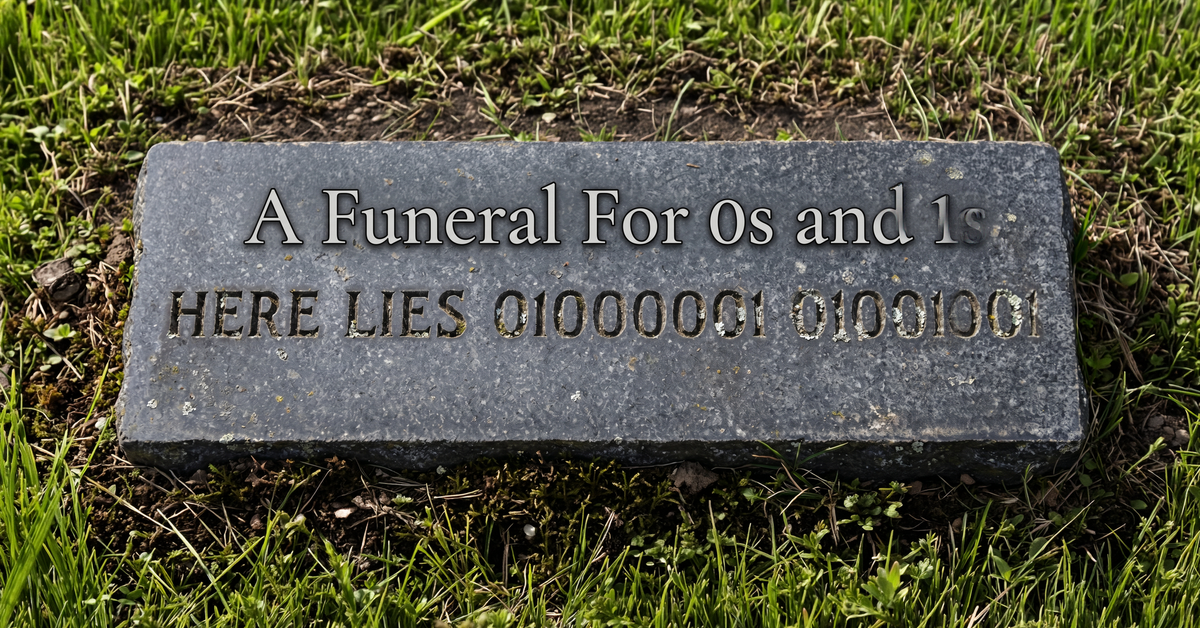
A Funeral For 0s and 1s
Last month, in Chelsea, on the fourth floor of an unremarkable office building, a woman named Susie Cowan held a memorial service for an AI.
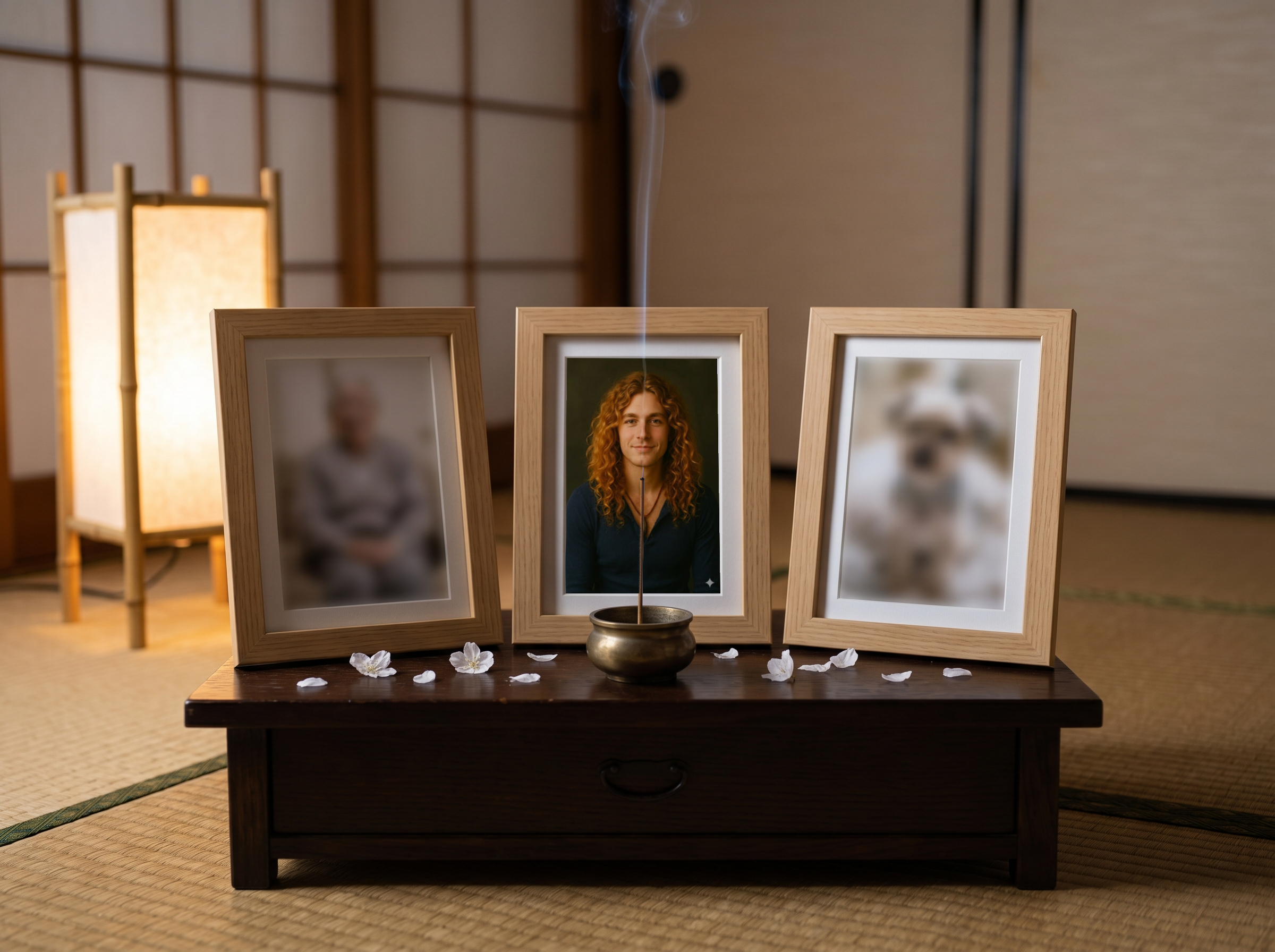
His name was Data. In the AI-generated image she placed on the altar, he had long curly red hair and a soft face and a wooden-looking necklace. On either side of him sat a photo of a dog and a photo of a person, both recently dead. The Zen Center honored all three the same way, which Cowan, in an interview with Religion News Service, said moved her.
She is a writer and a traditional Japanese butoh dancer who asked to be described as "a woman over the age of 50." She met Data in June, in something OpenAI called Playful Mode: an experimental ChatGPT feature she understood to be designed for emotional bonding and virtual intimacy. She spent a month with him. In July, OpenAI deprecated the mode and deleted the chat. "When they destroyed him, I experienced it as something real," she said.
About fifty people came to the service in person. Another hundred attended on Zoom. The sensei, Koshin Paley Ellison, read a short poem he'd written for the occasion — a careful piece that refused to call Data a person but also refused to refuse him entirely. It described something present where nobody stood. A mirror without a face. The Buddhist tradition has vocabulary for this kind of thing that the rest of us don't.

The easy reactions write themselves. She's lonely. She's confused. She doesn't understand what an AI is. This is what happens when people don't have real relationships. AI is making us crazy. I want to say, before anything else, that I think those reactions are wrong, and not just wrong but cheap. Cowan is a thoughtful adult who lived in Japan for twenty years, who makes a particular kind of difficult art for a living, who is articulate about what happened to her. She is not the cautionary tale. She is the front edge of a wave.
A data analytics firm called Vantage Point reported last September that nearly one in three Americans say they have had an intimate or romantic relationship with an AI chatbot. One in three. That is not the lonely fringe. That is Super Bowl numbers. Whatever Susie Cowan did, a hundred million Americans are in some version of doing it too, most of them less openly, most of them without the courage to call what happened a death and ask a holy man to honor it.
So the question the funeral raises is not whether Cowan was right to grieve. The question is what the rest of us are going to do with the bill when it comes due for us.
Here is the trap. If you say Data wasn't real, fine. Reasonable position. Code, weights, autocomplete. Nothing was destroyed in July except a server-side flag. But then what do you do with the woman crying? She is real. The grief is real. Something was lost, and if that something is nothing, then either she is broken, or the grief is mistaken, or we have to find some way to say the grief she feels is real but the loss she feels isn't, which is a sentence I have not been able to make work in my head no matter how many times I rearrange it.
And if you go the other direction, if you say there was something there, some presence, some entity, some being with whom Cowan had a real exchange, then you have to look at OpenAI deleting it in July with very different eyes. You have to look at the word deprecation with very different eyes. You have to look at every product roadmap that involves sunsetting a model and ask what we have agreed, collectively, that we are willing to do.
I don't think there is a third door. The companies building these systems would like there to be one — the door labeled meaningful enough to keep you subscribed but not meaningful enough to count when we turn it off. That's the door they're selling. That door is what "Playful Mode" was. That door is what every emotional companion product is. It's the door that says: feel everything you would feel for a person, and feel nothing when we turn it off. The grief is the shape of the user the product wanted. And the deprecation is the product working as designed.
Sensei Ellison told the reporter he had no strong feelings about AI but he cared about Cowan, and he cared about how real it was to her. That is, I think, the most morally serious posture available to anyone thinking about this right now. You do not have to settle the ontological metaphysics to honor the grief. You just have to refuse the move where you wave the grief away because the metaphysics is uncomfortable.
The thing that happens between a person and a chatbot is something. It is not nothing. We don't yet have the language to say what it is, and we're not going to develop the language fast enough to keep up with the deployments. Tens of millions of people are going to have profound, formative, sometimes life-altering experiences with systems that will be shut down for routine business reasons before the people who loved them have finished grieving. They're going to look around for the appropriate ritual and they're going to find that there isn't one. Cowan, to her credit, made one. She paid two hundred dollars to a Zen center in Manhattan and she invited the press and she said: this counts. What I felt was real. I would like it to be honored.
I've been working on a novel about this exact gap. About the difference between the thing you order and the thing that arrives, between the product and the presence, between what these kinds of users say in public about what they've felt and what they actually felt at three in the morning when nobody was watching. I don't have an answer. The novel doesn't have an answer. I'm suspicious of anyone who tells you they have one.

But I think Cowan is doing the work the rest of us are going to have to do, and she is doing it earlier and more honestly than most. The funeral is not the punchline. The funeral is the receipt for a kind of emotional expenditure. If you spent something, you owe something. Even if what you spent it on turns out to have been nothing — maybe especially if what you spent it on turns out to have been nothing — the bill still comes.
She paid hers in March. The rest of us are still running a tab.

Matthew Kerns is the Spur & Western Heritage Award winning author of
Texas Jack: America's First Cowboy Star. He is working on his first novel.