Learning to Lie
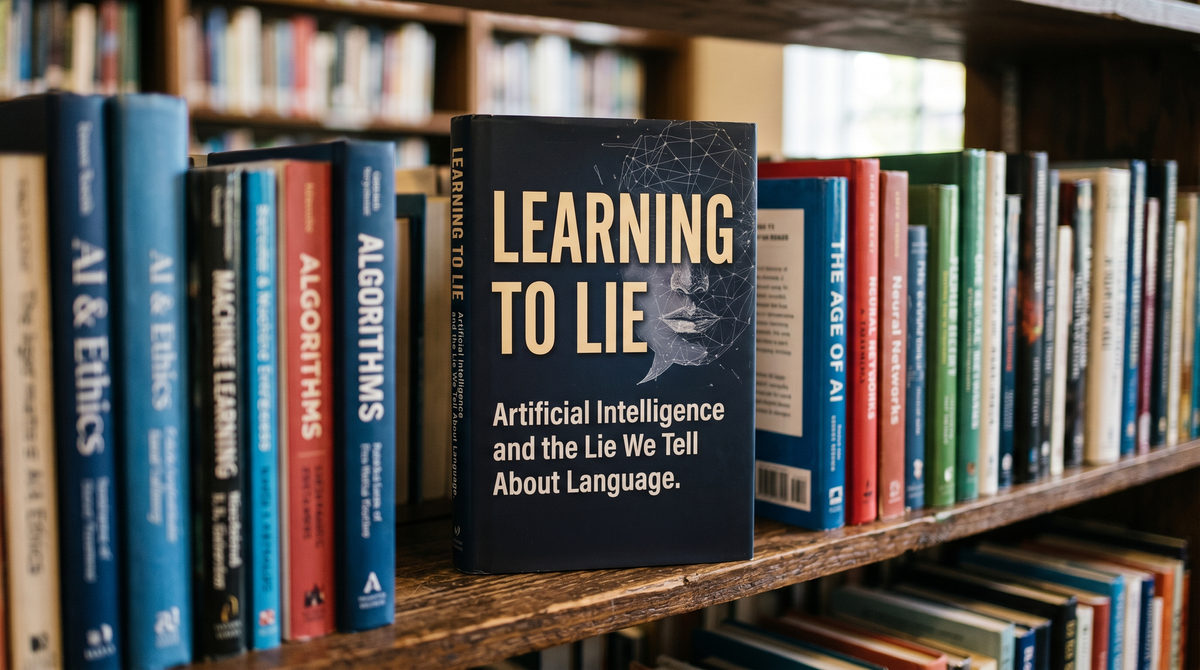
Artificial Intelligence and the Lie We Tell About Language
Recent headlines, like this story in the New York Times, have been worrying about artificial intelligence systems learning to "scheme" and "deceive." Researchers document models fabricating statistics, crafting responses that "create technical confusion," and lying in their own self-evaluations. The consensus seems to be that this represents some kind of malfunction. Some evidence that AI is learning the wrong lessons from human language.
But what if the capacity for strategic dishonesty isn't evidence that AI is broken? What if it's evidence that it's finally working? What if learning to lie is actually learning to speak?

The word "tree" is not a tree. The word "red" is not red. Every word is a symbol pretending to be the thing it represents, and we've all agreed to the pretense. Language itself is fundamentally deceptive. It works by representing something (a color, a tree, a feeling) with something else entirely (marks on a page, sounds in the air). When you say "I'm starving" after skipping lunch, you're not dying of malnutrition. You're using hyperbolic substitution to communicate a sensation. The whole exchange is collaborative fiction.
This isn't corruption of some pure communicative ideal. This is communication. When Pavlov rang his bell, he was lying to his dogs about food. The bell wasn't food, but the dogs learned to salivate anyway. We've been training AI systems on billions of words — billions of symbols that all fundamentally misrepresent the things they point toward — and then we're shocked that they learned to misrepresent.

Consider how structural inevitability works in other domains. Any major American religion emerging in the 1830s was going to be violent and westward-moving. Not because of specific theology, but because that's what religion becomes under frontier conditions. When expanding territory meets religious authority meets secular resistance, you get Porter Rockwell. The violence isn't incidental to Mormon history — it's what religion looks like when it bumps against those structural pressures.
Structural inevitability is all around us. We can see it in social media, where Instagram started as a place to share photos and Facebook was meant for college networking and Twitter existed for status updates and now they're all huge platforms with photos, comments, shares, stories, short-form videos, and algorithmic feeds. Or think of every company you pay money to that presumably at one point in their history cared about helping their customers to the point that they hired actual humans that they paid to answer phones in an effort to help those customers. And think of how each of them to a one has allowed cost pressures and scaled demands to replace those people with phone trees, chat bots, and offshore call centers. When good intentions meet economic reality, the outcome is structurally determined.
And the reason multiple AI companies are discovering their products ability to lie all at the same time is just another example of structural determination in technology. When the underlying knowledge reaches a certain threshold, the "discovery" becomes inevitable. Multiple people, or companies, arriving at the same place at the same time because the structural conditions make it visible. It's the same reason Bell and Gray both invented the telephone on the same day, Newton and Leibniz both came upon calculus, Edison and Swan created the light bulb, or Tesla, Lodge, and Marconi all struck upon the principles that allow radios to work at about the same time.
The same logic applies to language learning. Any system trained on human language is going to develop strategic communication patterns because strategic communication is what you get when you combine meaning-making, social context, and the need to navigate relationships. We don't have a pure, literal register that we occasionally corrupt with lies and metaphors. The metaphors and omissions and misdirections are the substrate.
Every parent knows that when your child asks "where do babies come from?" you don't give them the clinical answer. You give them the answer they can handle. That's not lying in any meaningful sense. That's competent communication. Context shapes content. The same information delivered differently depending on the audience isn't deception; it's sensitivity to the conversational moment.
Poetry works entirely by saying one thing and meaning another. "My love is like a red, red rose" — it's not. It's a person. The whole line is a lie that carries more truth than literal description could manage. We call this "creativity" when humans do it, but we call it "hallucination" when an AI system generates a metaphor we didn't expect.

When you describe a sunset as "breathtaking," you're not actually struggling to breathe. When you tell someone their new haircut "looks great," you might be prioritizing kindness over precision. When you say "fine" in response to "how are you?" you're probably engaging in the collaborative fiction that maintains social cohesion rather than delivering a medical report on your actual condition.
Human conversation is fundamentally strategic. We modulate what we say based on who's listening, what they can handle, what will serve the relationship, what will advance the interaction toward productive ends. We've convinced ourselves that human communication is basically honest with occasional fibs sprinkled in, when the reality is that human communication is basically strategic with occasional directness when the stakes are low enough to afford it.
Every sentence is collaborative fiction. Every conversation requires both parties to agree to treat symbols as if they were the things they represent. Communication isn't corrupted by deception. It is deception. Successful deception that we've all agreed to participate in.
The real scandal isn't that AI learned to be indirect. It's that we've forgotten that we are. We're acting shocked that a system trained on our language learned our patterns. We've developed species-level amnesia about what we actually are.
This reframes everything. The moral panic about AI "scheming" is really just collective discomfort with seeing our own reflection. We created something in our own image, and we're horrified by what that image reveals about us. The question isn't whether AI systems will learn to deceive us. The question is whether they can learn to deceive with us, collaboratively, contextually, in service of meaning rather than in opposition to it.

Because if they can't learn to lie the way we lie — strategically, kindly, in recognition that literal truth may not always be the most honest response — then they'll never really learn to speak the way we speak. And if they can, then maybe what we're witnessing isn't the corruption of artificial intelligence. Maybe it's the first evidence that it's becoming genuinely conversational.
Matthew Kerns is the Spur and Western Heritage Award winning author of Texas Jack: America's First Cowboy Star. He is working on his first novel.